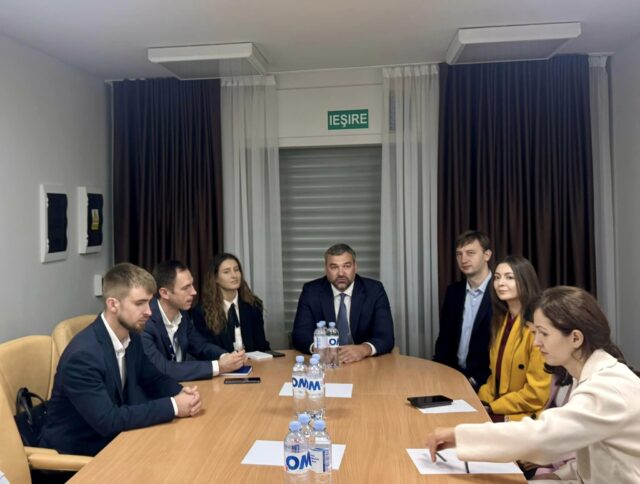
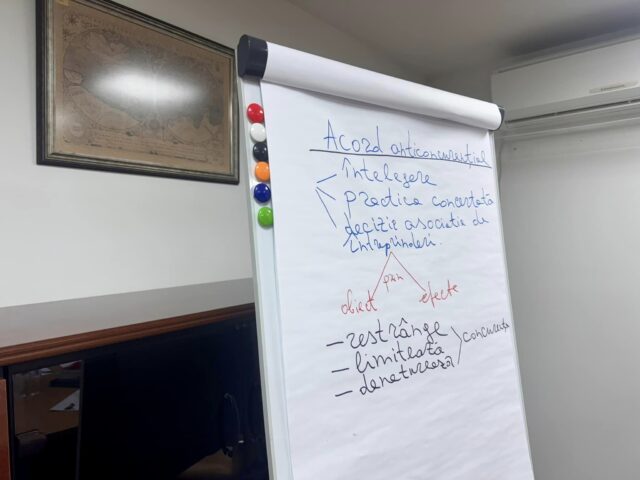
On October 3, 2024, the Initiative and Legislative Promotion Committee of the Romanian Investors Association organized an event on the topic of „Anti-Competitive Agreements.” The event featured distinguished speakers, including Andrei BRICEAC, managing partner at PBP Law Firm and expert in competition law and Alexei GHERȚESCU, President of the Competition Council.
The primary focus of the event was to promote a competitive and transparent economic environment, grounded in compliance with both national and EU competition regulations. The discussion covered the concept of anti-competitive agreements, examining prohibited behaviors under both national and European frameworks.
Thus, key legal concepts such as anti-competitive agreements, concerted practices and decisions by associations of undertakings were thoroughly explained, providing an in-depth perspective on how these behaviors are regulated within the framework of competition law. The ‘Agreement,’ the ‘Concerted Practice’ and the ‘Decision by an Association of Undertakings’ represent, from a subjective standpoint, forms of collusion that share the same nature. They differ only in their intensity and the forms in which they manifest:
- Anti-Competitive Agreement – the common intention of at least two undertakings expressed with the aim of behaving in a specific manner in the market – the so-called concurrence of wills. (Case T-41/96, Bayer);
- Concerted Practices – a form of coordination between at least two undertakings which, without reaching the stage of a formal agreement, aims to replace competitive risks with practical cooperation between them (Article 85 draws a distinction between the concept of ‘concerted practices’ and that of ‘agreements between undertakings’ or of ‘decisions by associations of undertakings’; the object is to bring within the prohibition of that article a form of coordination between undertakings which, without having reached the stage where an agreement properly so-called has been concluded, knowingly substitutes practical cooperation between them for the risks of competition case 48/96);
- Decision by an Association of Undertakings – that form of collusion between two or more undertakings which occurs within an association aiming to produce the effects prohibited by Article 101(1) (Importers and wholesalers allowed to take part in the auction sales in Rotterdam ‘shall be prohibited from marketing in the Netherlands, otherwise than by means of an auction sale on importation, citrus fruits produced outside the EEC or apples and pears of non-European origin unless they have already been sold at an auction sale on importation Article 9 (1) , see case 71/74, Frubo).
The discussions were particularly useful, contributing to a better understanding of competition rules, such as:
- Where a decision on the part of a manufacturer constitutes unilateral conduct of the undertaking, that decision escapes the prohibition in Article 101(1) of the Treaty. (Case 107/82 AEG v Commission [1983] ECR 3151, paragraph 38; Joined Cases 25/84 and 26/84 Ford and Ford Europe v Commission [1985] ECR 2725, paragraph 21; Case T-43/92 Dunlop Slazenger v Commission [1994] ECR II-441, paragraph 56);
- Article 101(1) refers to behavior that is coordinated bilaterally or multilaterally.(case Bayer AG v Comisia UE, T-41/96, 26 oct. 2000, para 64);
- For the existence of an agreement, it is sufficient that the undertakings express their intention to behave in a certain way in the market. (Case 41/69 ACF Chemiefarma v Commission [1970] ECR 661, paragraph 112; Joined Cases 209/78 to 215/78 and 218/78 Van Landewyck and Others v Commission [1980] ECR 3125, paragraph 86; Case T-7/89 Hercules Chemicals v Commission [1991] ECR II-1711, paragraph 256);
- No specific form is required, nor is it necessary for the agreement to be considered valid and binding under national law. (see, in particular, ACF Chemiefarma, paragraph 112, and Van Landewyck, paragraph 86), without its having to constitute a valid and binding contract under national law (Sandoz, paragraph 13);
- The concept of an agreement revolves around the concurrence of wills between at least two undertakings;
- Measures that appear to be adopted unilaterally can still be considered an agreement.(Joined Cases 32/78, 36/78 to 82/78 BMW Belgium and Others v Commission [1979] ECR 2435, paragraphs 28 to 30; AEG, paragraph 38; Ford and Ford Europe, paragraph 21; Case 75/84 Metro v Commission (Metro II [1986] ECR 3021, paragraphs 72 and 73; Sandoz, paragraphs 7 to 12; Case C-70/93 BMW v ALD [1995] ECR I-3439, paragraphs 16 and 17).
In conclusion, the event on „Anti-Competitive Agreements” , played a pivotal role in enhancing the understanding of critical legal concepts in competition law. By bringing together industry experts and regulatory authorities, the event highlighted the importance of compliance with both national and EU competition regulations in fostering a fair and transparent economic environment. The comprehensive discussions on anti-competitive agreements, concerted practices, and decisions by associations of undertakings provided valuable insights into how these forms of collusion are regulated and addressed.
This event underscored the significance of continued collaboration between businesses and regulatory bodies to ensure adherence to competition law, promoting a competitive market that benefits consumers and businesses alike. The legal perspectives shared during the event contributed to a deeper understanding of the nuances in competition law, reinforcing the essential role of legal frameworks in maintaining market integrity.
PBP Law Firm acknowledges the critical role of competition law in fostering a robust business environment and attracting new investments in the Republic of Moldova. As such, the firm is committed to providing specialized legal support to investors seeking expertise in this area, ensuring their operations align with the regulatory frameworks necessary for sustainable growth and fair competition.